


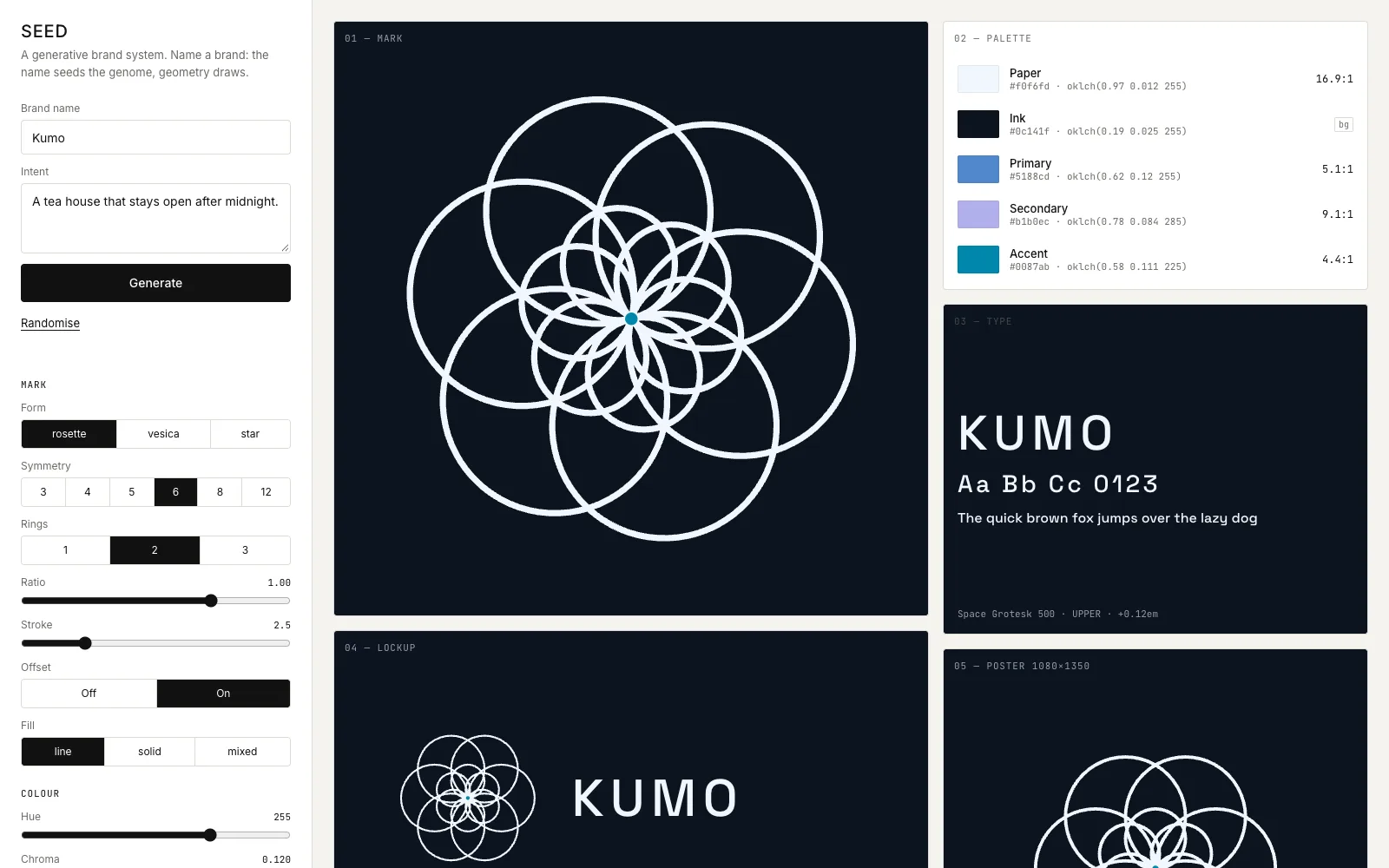
SEED: Generative Brand System
What if a brand name were the seed for its whole identity?
Role: Concept, Design & Development (Next.js, TypeScript, SVG) · 2026
Built a one-page tool that turns a brand name and a one-line intent into a complete identity system: a sacred-geometry mark with its own motion, an OKLCH palette with contrast ratios, a type style, a lockup, a 1080×1350 poster and app icons. Every parameter has a control, so the seeded result is a starting point the designer can override, and the exact board travels in a share link.
Technical decisions
- The name and intent are hashed (FNV-1a → mulberry32) into a 17-parameter genome, so the same input always grows the same system
- One strict normaliser sits between every source — seed, share URL and sliders — and the renderer; it clamps and snaps values and never throws
- Every graphic is inline SVG drawn by pure functions, with no canvas or graphics library, so the mark exports as a standalone SVG
- Palettes are built in OKLCH, and the primary is nudged until it reaches 3:1 WCAG non-text contrast; ink and paper stay above 7:1
Responsibilities
- Designed the genome: 17 parameters across mark, palette, type and motion
- Implemented rosette, vesica and {n/m} star geometry that always fits a fixed outer bound
- Built loop-exact motion (breathe, orbit, unfold) that pauses off-screen and respects prefers-reduced-motion
- Wrote an OKLCH → sRGB colour pipeline that maps out-of-gamut colours back by binary-searching chroma
- Added share-URL state encoding and SVG export of the mark
- Planned the system in a written spec first, then implemented it with Claude Code from that plan
Achievements
- Fully reproducible: the whole state fits in a share URL and redraws identically
- Numeric self-checks cover the genome, colour, geometry, motion and share encoding
- App icons stay legible down to 32px through optical stroke correction
- Runs with no environment variables or API keys
Technologies
Next.jsTypeScriptSVGOKLCHReactSCSS Modules